TDS Saddlers

sales@tds-saddlers.com  |  01420 562758

  • Buy in Euros
  • Payment Options
  • Home
  • About Us
  • Contact Us
  • My Account
  • View Basket
  • Forums
  • Help
  • Returns Policy
  • Shop By Product
  • Shop By Brand
  • Saddles
  • Saddlery & Tack
    • Bridles, Reins & Parts
      • Bridles
      • Double Bridles
      • Reins
      • Bridle Parts
      • Bridle Accessories
    • Headcollars & Leadropes
    • Martingales & Breastplates
    • Bits & Bitting
    • Stirrup Leathers & Irons
    • Girths
    • Leather & Tack Care
    • Horse Boots and Bandages
    • Numnahs & Saddle Pads
    • Traveling & Training Equipment
  • Horse Rugs
  • Footwear
  • Riding Wear
  • Leisure Wear & Gifts
  • Horse Care
  • Stable & Field
  • Feed Supplements & Treats
  • Pony Shop
  • Follow Us on Facebook
Can we help you find what you are looking for?
*Try entering Brands, Products and Categories.
Your Basket

There are no items in your basket.

Bridles, Reins & Parts > Bridles

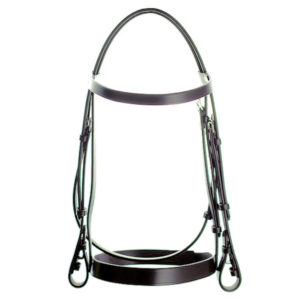
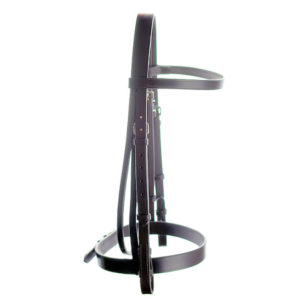
The bridle is used to direct the horse, The English Oxford Dictionary defines the ‘bridle’ as a piece of equipment that includes a ‘Headstall’ that holds a ‘Bit’ in the horses mouth and the ‘Reins’ that are attached to the bit by which the rider gives direction.
Types of Bridle

Snaffle bridle : Is a basic bridle that carries one bit and usually has one set of reins. Despite the name, a snaffle bridle may be used not only with a snaffle bit, but also with almost other types of single rein bits, including kimberwickes, gag bits, and single curb bits.

Pelham bridle: The Pelham is another English type bridle that carries a single bit, in this case a Pelham bit, but two sets of reins, one for snaffle action and one for curb action.

Double bridle: Also called a Weymouth bridle, double bridles use two bits at once, a small snaffle called a bradoon and a curb or Weymouth bit, and require the use of two sets of reins. Double bridles are usually only seen used in upper level dressage, and for showing in certain other events that require formal attire and equipment.

Gag bridle: a bridle with rounded cheekpieces that pass through the top and bottom holes in the bit ring of a gag bit and attach directly to the reins. Tension on the reins rotates the bit and slides it up the cheekpieces and into the corners of the lips Gag bridles have the potential for severe action. They are often seen in polo, rodeo speed events, and occasionally show jumping. They are not permitted in most other horse show competition. In polo, they are often used with double reins, in the same manner as a Pelham bridle.

Nosebands

The noseband was originally made of leather or rope and consisted of a simple strap around the nose with another attached over the poll, this was the first tool used by humans to control horse’s. After the invention of the bit, the noseband was, simply used as a halter worn beneath the bridle that allowed the rider to remove the bit from the horse's mouth after work and to tie the horse by this halter, instead of by the bit, which could result in damage to the horse's mouth if it panicked. However, its ability to hold a horse's mouth shut over the bit was also recognised, as was its usefulness for attaching equipment such as a martingale, and so in some cultures it was sometimes left as a working part of a bridle.

Use of the Noseband

First, to give a balanced and traditionally correct appearance. When raised high, it can make a long-nosed horse's face look shorter and more proportional. Various positions up and down the nose may help the face look more handsome, and a wide noseband can make a heavy head appear more delicate.

Second, to keep the horse's mouth closed or at least prevent a horse from evading the bit by opening the mouth too far. It can sometimes prevent the horse from putting its tongue over the bit and avoiding pressure in that manner

Third, the noseband is also used to help stop a horse from pulling. A stronger noseband can often be used instead of a stronger bit, which makes it a usefull option for riders that want more control, but do not want to make the horse afraid to go forward,or ‘back off’, especially when jumping, which is often an undesirable consequence when the horse is placed in a strong or harsh bit.

Fourth, it can be an attachment for other equipment, such as a standing martingale.

It is also valuable for young horses just learning to go "on the bit", as it supports and helps relax the the and flex softly at the poll.

In some riding styles, a noseband is added simply for decoration and is not attached to the bridle or adjusted to serve any useful purpose.

Nosebands may add some pressure to the nose when the reins are applied, depending on adjustment, style and the degree to which the horse resists the bit. With a soft leather noseband on a well-trained horse, the effect is minimal.

A bridle does not necessarily need a noseband, and many bridles, such as those used in Western riding, flat racing, or endurance riding, do not have one. Some horses shown in-hand do not use a noseband in order to better shows off the animal's head. Many old paintings also depict a hunting horse without a noseband, since it was not always deemed useful by certain riders.

However, even in disciplines such as western riding, where it is considered a sign of a polished horse to not require a noseband or cavesson, one is often used on horses in training as a precaution to help prevent the horse from learning bad habits such as opening the mouth and evading the bit.

Types of Noseband

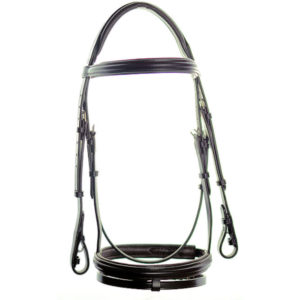
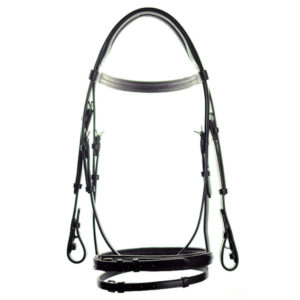
Plain or Cavesson: a noseband that encircles the nose 1-2 inches below the cheekbone. This type of noseband is seen in most English disciplines, especially in dressage, show hunters, and hunting, but is the basic noseband for all disciplines and so is never an unusual sight. This noseband comes in various styles from a plain flat leather suitable for hunting, to raised, double raised, fancy stiched and padded styles. All of them perform the same purpose. Fitting: The headpiece should be adjusted so that the noseband sits roughly equidistant between the prominent cheek bone and the horse's lips. Around the nose and jaw, this cavesson should be fitted so that, depending on the size of the horse and the size of the rider's hand, one or two fingers can be easily inserted between the noseband and the top of the nose. It should not be "cranked" tight.

Drop noseband: Invented by the Spanish Riding School, this noseband encircles the nose around the chin groove, as opposed to just below the cheekbone, with the strap on the nasal bone, and never below it. It reminds the horse to keep his mouth closed and prevents the horse from crossing his jaw. Due to its position, it should not be used with a standing martingale. A drop noseband is not as suitable for galloping work as the other nosebands, as it tends to restrict the nostrils if it is fitted incorrectly. Although the drop used to be very popular in dressage, it is very rarely seen today, partly because many riders dislike the look it gives the horse's head. However, most horses prefer the drop noseband to the flash, and it is a very useful piece of equipment. Fitting: This should be fitted on the nasal bone, with the strap and buckle fastening below the bit in the chin groove. Care should be taken not to allow the top part to rest below the nasal bone - if it presses on the soft tissue below this bone it can impede breathing. In general, a drop noseband should not be fitted as tightly, nor should the flash piece of a flash noseband, as the horse's nostrils will be constricted.

Flash noseband or Aachen noseband: The flash was originally developed for show jumping riders, so they could close the mouth lower down in addition to having an appropriate noseband for a standing martingale. An additional feature of this noseband is that it holds the bit steady in the horse's mouth, which some horses prefer. The noseband is similar to the plain cavesson in that the top part encircles the nose 1-2 inches below the cheekbone, but it also includes a second strap that runs from the cavesson, around the nose in front of the bit and under the chin groove, then coming back around to the cavesson. This second piece is used to help keep the horse's mouth closed and to keep the horse from crossing his jaw. A flash noseband may be used with a standing martingale when the martingale is attached to the cavesson piece. This noseband is usually seen at the lower levels of dressage, or in the dressage phase of eventing. Fitting: as the drop noseband, but somewhat tighter to prevent the noseband being pulled down towards the end of the muzzle by the lower flash strap. The lower flash strap runs below the bit and under the chin groove. With the buckle done up, the remainder of the strap should point downwards, not up towards the top of the horse's nose as is often seen.

Crank noseband or Swedish Cavesson: used most often on dressage horses at levels where a double bridle is worn, this noseband is similar to the plain cavesson except it is designed to be easy to get very tight, so as to keep the horse's mouth closed. Double bridles cannot use flash or drop cavessons, so the crank is seen on upper level dressage horses who will not keep the mouth shut. It is also used occasionally on show hunters The down side is the horse can't open his jaw at all when the crank is tight, so he cannot relax the jaw and properly move into the bit. Additionally, it can push the cheeks against the horse's teeth when over-tightened, which is painful. Fitting: Opinions vary on the tightness a noseband should be fitted. Some believe it should be extremely tight, to prevent the horse from opening or crossing its jaws. Others think that the noseband should be more of a reminder to the horse to not open its mouth, should only prevent excessive gaping of the mouth, and that good riding will solve most issues. In this case, a finger should be able to pass between the noseband and the horse at any point.

Hanoverian: Also called a "crank with flash" this is the same as a flash noseband, but with the addition of a padded jawband like a crank noseband has. It operates to hold the horse's mouth shut and hold the bit steady in the horses' mouth. It is very commonly found on dressage bridles.

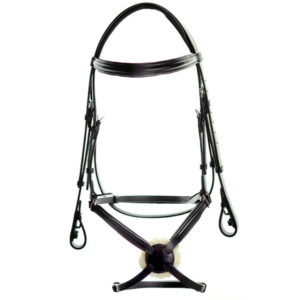
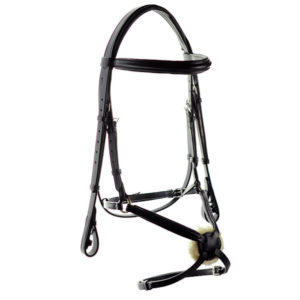
Grackle: Also called a crossed, Mexican noseband, this noseband crosses from the top of the ckeekbone on one side, over the nose to the chin groove on the other side, under the horse's chin, and back up to the opposite cheekbone. It is used to remind the horse to keep its mouth closed and prevents him from crossing his jaw, and its design provides more expansion of the nostrils, which is preferable for horses performing work involving galloping (eventing, polo, racing), and has always been popular in show jumping. Many people believe that this type of noseband is more comfortable than a flash.

Kineton or Puckle: Originating in horse racing for animals who would be uncontrollable at high speeds, this noseband often cited as being more severe than the others listed above. It works by transferring bit pressure from the rider's hand to the nose. However, it is possible that it may work not because of pain, but because the horse responds better to noseband pressure than to bit pressure (which can be painful and cause the horse to run out of fear). The kineton has metal half-rings that pass under the bit, and a leather strap that sits below the bit and over the nose (which it does not encircle) about where a drop noseband would cross. There is no strap to keep the horse's mouth closed. This noseband should only be used with a snaffle bit (which should be slightly wider than usual to take into account the half-rings), and a martingale should not be attached to the noseband. This is most commonly seen in eventing on the cross-country phase, and in show jumping. This noseband is most suited for horses that are hard pullers, allowing the rider to ride lightly with a mild bit and still stop a strong horse. It is also popular for use on hot horses, to get them to trust the bit and relax.

Worcester: The Worcester noseband looks in some ways like a flash but has two independent straps that lead from the middle of the noseband and attach to each side of the horses bit. Its effectiveness is the way it helps prevent the horse getting its tongue over the bit and stops it opening its mouth. However, it is also good for turning and putting pressure onto the horse’s nose, thus taking sole emphasis away from the bit.

Hackamore: or bitless bridle exerts pressure on the poll, nose and curb groove. Being bitless, there is no control coming through the mouth or bit, so this sort of leather bridle is often used in endurance riding and dressage where strong contact on the horse’s mouth is not required. Hackamores are also seen in showjumping, especially the showjumping phase of a Three Day Event. Often they have a fleecy sheepskin covering; this is put there so the horse has to lower its head to see over the fleece and thus will not chuck its head up and evade the contact.

Australian cheeker noseband: "Australian noseband", or "cheeker": this noseband consistes of a Y-shaped rubber fork, which is buckled to the center of the poll strap, the forks dropping to either side of the nose, with the ends having round rubber cheek guards that fit over the bit. Used to prevent the bit being pulled through the horse's mouth, as well as to keep the bit raised in the horse's mouth. It is an effective and kind option for a puller or a horse who gets his tongue over the bit. Most commonly seen at the race track.

Parts of the bridle

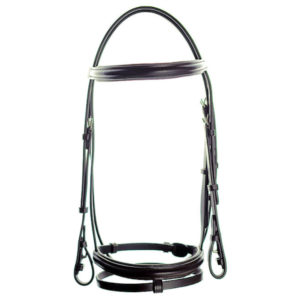
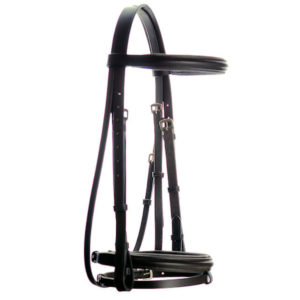
The bridle consists of the following elements:

Headpiece: The headpiece goes over the horse's head just behind the ears, at the poll (a point immediately behind or right between the ears). It is the main strap that holds the remaining parts of the bridle in place. The strap is split at both ends, the unsplit part rests on the poll. The wider front split on each end are called the Cheek Straps to which the Cheekpieces attach and are of equal length. The back splits on each end, known as the Throatlash and Throatlash Buckle Strap, are of unequal length, the shorter has a buckle end and is the same length as the cheek straps the longer buckles into the shorter around the horse’s throat.

Cheekpieces: Or Cheeks, on most bridles, two cheekpieces attach, one either side of the headpiece and run down the side of the horse's face, along the cheekbone and attach to the bit rings.

Throatlash: Runs from the horse's right ear, under the horse's throat, and attaches below the left ear. The main purpose of the throatlatch is to prevent the bridle from coming off over the horse's head, which can occur if the horse rubs its head on an object, or if the bit is low in the horse's mouth and tightened reins raise it up, loosening the cheeks

. Browband: The headpiece runs through the browband. The browband runs from just under one ear of the horse, across the forehead, to just under the other ear. It prevents the bridle from sliding behind the poll onto the upper neck, and holds multiple headstalls together when a cavesson or second bit is added, and holds the throatlatch in place on designs where it is a separate strap.

Noseband: Encircles the nose of the horse. It is often used to keep the animal's mouth closed, or to attach other pieces or equipment, such as martingales.

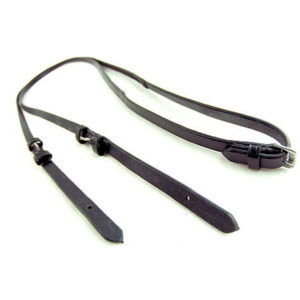
Reins: The reins of a bridle attach to the bit, below the attachment for the cheekpieces. The reins are the rider's link to the horse, and are seen on every bridle. Reins are often laced, braided, have stops, or are made of rubber or some other tacky material to provide extra grip.

Bit: The bit goes into the horse's mouth, resting on the sensitive interdental space between the horse's teeth known as the "bars."

On a double bridle, where the horse carries two bits (a curb and small snaffle, often called a "bit and bradoon"), a second, smaller headstall, known as a ‘slip head’ is used to attach the bradoon. A second set of reins is attached to the bradoon, and hence the rider carries four reins.

The bridle, depending on style, may also contain some of the following elements:

Bit guards: Bit guards are optional fittings used on some bits.

Curb strap or curb chain, used primarily on bridles with a curb bit, a small strap or chain, usually flat, that runs from one side of the bit to the other, and puts pressure on the chin groove when curb reins are tightened.

Lip strap: a small strap used on a few curb bit designs, attaches between the bit shanks of a curb bit at the halfway point, used to keep the curb chain properly positioned and may prevent the horse from grabbing at the shanks with its lips.Close Info

Learn more...

To compare, click up to 4 boxes and click
Compare:
Albion KB Competition Snaffle Bridle

Albion KB Competition Snaffle Bridle


Compare:
Bridleway Comfort Bridle

Bridleway Comfort Bridle

Usual Price:  £53.50
Compare:
Bridleway Padded Bridle

Bridleway Padded Bridle

Usual Price:  £49.95
Compare:
Bridleway Plain Leather Snaffle Bridle

Bridleway Plain Leather Snaffle Bridle

Usual Price:  £49.95
 
 
Compare:
Horseware Rambo Micklem Multi Bridle

Horseware Rambo Micklem Multi Bridle

Usual Price:  £131.05
Online Price: £124.50
Compare:
In Hand Bridle

In Hand Bridle

Usual Price:  £42.99
Online Price: £40.84
Compare:
Jeffries IR Bridle

Jeffries IR Bridle

Usual Price:  £205.00
Online Price: £194.75
Compare:
Jeffries Premier Padded Bridle

Jeffries Premier Padded Bridle

Usual Price:  £165.00
Online Price: £156.75
 
 
Compare:
Jeffries Snaffle with Flash Noseband

Jeffries Snaffle with Flash Noseband

Usual Price:  £205.00
Online Price: £194.75
Compare:
Jeffries Snaffle with Mexican Grackle

Jeffries Snaffle with Mexican Grackle

Usual Price:  £220.00
Online Price: £209.00
Compare:
Jeffries Snaffle with Show Noseband

Jeffries Snaffle with Show Noseband

Usual Price:  £195.00
Online Price: £185.25
Compare:
Keiffer Belinda Bridle

Keiffer Belinda Bridle

Usual Price:  £78.25
Online Price: £74.34
 
 
Compare:
Keiffer Ergonomic Line Bridle

Keiffer Ergonomic Line Bridle

Usual Price:  £88.05
Online Price: £83.65
Compare:
Keiffer Ergonomic Line II Bridle

Keiffer Ergonomic Line II Bridle

Usual Price:  £92.95
Online Price: £88.30
Compare:
Keiffer Ergonomic Line III Bridle

Keiffer Ergonomic Line III Bridle

Usual Price:  £95.89
Online Price: £91.10
Compare:
Keiffer Innsbruck Bridle

Keiffer Innsbruck Bridle

Usual Price:  £107.69
Online Price: £102.31
 
 
Compare:
Keiffer Katherina Bridle

Keiffer Katherina Bridle

Usual Price:  £89.05
Online Price: £84.60
Compare:
Leather Bridle With Narrow Nose Band

Leather Bridle With Narrow Nose Band

Usual Price:  £79.95
Online Price: £75.95
Compare:
Leather Bridle with Wide Nose Band

Leather Bridle with Wide Nose Band

Usual Price:  £79.95
Online Price: £75.95
Compare:
Leather Hunt Bridle

Leather Hunt Bridle

Usual Price:  £79.95
Online Price: £75.95
 
 
Compare:
Mark Todd Grackle Bridle

Mark Todd Grackle Bridle

Usual Price:  £110.00
Online Price: £104.50
Compare:
Mark Todd Square Raised Bridle

Mark Todd Square Raised Bridle

Usual Price:  £110.00
Online Price: £104.50
Compare:
Passier Aquarius Snaffle Bridle

Passier Aquarius Snaffle Bridle

Usual Price:  £220.00
Online Price: £209.00
Compare:
Passier Bremen Snaffle Bridle

Passier Bremen Snaffle Bridle

Usual Price:  £645.00
Online Price: £612.75
 
 
Compare:
Passier Scorpius Snaffle Bridle

Passier Scorpius Snaffle Bridle

Usual Price:  £212.00
Online Price: £201.40
Compare:
Stubben 1000 Bridle

Stubben 1000 Bridle

Usual Price:  £149.00
Online Price: £141.55
Compare:
Stubben 1085 Crank Caveson Bridle

Stubben 1085 Crank Caveson Bridle

Usual Price:  £250.95
Online Price: £238.40
Compare:
Stubben Carlow Flash Rolled Bridle

Stubben Carlow Flash Rolled Bridle

Usual Price:  £270.95
Online Price: £257.40
 
 
Compare:
Stubben Donegal Bridle

Stubben Donegal Bridle

Usual Price:  £189.00
Online Price: £179.55
Compare:
Stubben Padded Caveson Bridle

Stubben Padded Caveson Bridle

Usual Price:  £157.00
Online Price: £149.15
Compare:
Thetford Bridle

Thetford Bridle

Usual Price:  £49.99
Online Price: £47.49
 
 
  • © 2009 TDS Saddlers. All Rights Reserved.
  • Site by DCSL Software
  • HomepageFitting GuidePrivacyTermsShipping